
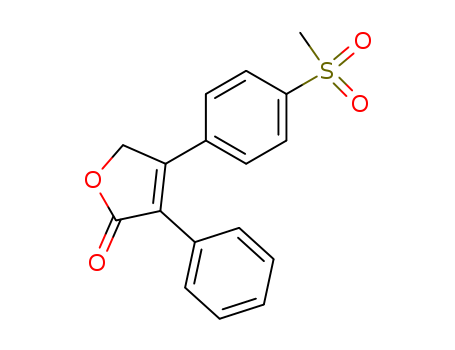
Rofecoxib
- CasNo:162011-90-7
Product Description
Cost-effective and customizable Rofecoxib 162011-90-7 for sale
- Molecular Formula:C17H14O4S
- Molecular Weight:314.362
- Appearance/Colour:off-white (pale yellow) crystalline powder
- Vapor Pressure:2.42E-13mmHg at 25°C
- Melting Point:207 °C
- Refractive Index:1.619
- Boiling Point:577.6 °C at 760 mmHg
- Flash Point:303.1 °C
- PSA:68.82000
- Density:1.333 g/cm3
- LogP:3.63850
Rofecoxib(Cas 162011-90-7) Usage
|
Indications |
Rofecoxib is approved for the treatment of osteoarthritis, dysmenorrhea, and acute pain. The most common adverse reactions to rofecoxib are mild to moderate GI irritation (diarrhea, nausea, vomiting, dyspepsia, abdominal pain). Lower extremity edema and hypertension occur relatively frequently (about 3.5%). It is not metabolized by CYP2C9, so rofecoxib should not be subject to some of the interactions seen with celecoxib. However, its metabolism is increased by the coadministration of rifampin, which acts as a nonspecific inducer of hepatic metabolism. |
|
Biochem/physiol Actions |
Rofecoxib is derived from furanone and has the ability to cross human placenta. Along with anti-inflammatory action, it possesses analgesic and antipyretic properties. Cytosolic hepatic enzymes are responsible for the metabolism of rofecoxib. It is known to cause oligohydramnios and ductus arteriosus constrictions. Rofecoxib inhibits the action of CYP1A2 (cytochrome P450 family 1 subfamily A member 2). It might be associated with aseptic meningitis. Rofecoxib is known to ameliorate the risk of colorectal adenoma, but might contribute to toxicity. |
|
Mechanism of action |
Rofecoxib is excreted primarily in the urine (72%) as metabolites. Less than 1% is excreted in the urine as unchanged drug, whereas approximately 14% is excreted in the feces as unchanged drug. Although the metabolism of rofecoxib has not been fully determined, the microsomal cytochrome P450 system appears to play only a minor role—a major difference in the metabolic routes of rofecoxib and celecoxib. The major metabolic route appears to form reduction of the dihydrofuranone ring system by cystolic enzymes to the to cis- and trans- dihydro derivatives. Also isolated is the glucuronide of a hydroxy derivative that results from CYP2C9 oxidative metabolism. None of the isolated metabolites of rofecoxib possess pharmacological activity as COX-1 or COX-2 inhibitors. |
|
Pharmacokinetics |
Rofecoxib has been synthesized by a number of synthetic routes that have been summarized elsewhere. It was the second selective COX-2 inhibitor to be marketed. Rofecoxib is well absorbed from the GI tract on oral administration, with peak plasma levels generally being attained within 2 to 3 hours of dosing. Bioavailability averages 93% following administration of a single dose. The area under the plasma concentration–time curve is increased in patients older than 65 years compared to younger adults and is increased slightly in black and Hispanic patients compared with white patients, but the difference is not considered to be clinically significant. |
|
Definition |
ChEBI: A butenolide that is furan-2(5H)-one that is substituted by a phenyl group at position 3 and by a p-(methylsulfonyl)phenyl group at position 4. A selective cyclooxygenase 2 inhibitor, it was used from 1999 to 2004 for the tr atment of ostoarthritis, but was withdrawn following concerns about an associated increased risk of heart attack and stroke. |
|
Brand name |
Vioxx (Merck). |
InChI:InChI=1/C17H14O4S/c1-22(19,20)14-9-7-12(8-10-14)15-11-21-17(18)16(15)13-5-3-2-4-6-13/h2-10H,11H2,1H3
162011-90-7 Relevant articles
Electrochemical oxygenation of sulfides with molecular oxygen or water: Switchable preparation of sulfoxides and sulfones
Li, Jin-Heng,Li, Yang,Sun, Qing,Xue, Qi,Zhang, Ting-Ting
supporting information, p. 10314 - 10318 (2021/12/17)
A practical and eco-friendly method for ...
Selective oxidation of (hetero)sulfides with molecular oxygen under clean conditions
Liu, Kai-Jian,Deng, Ji-Hui,Yang, Jie,Gong, Shao-Feng,Lin, Ying-Wu,He, Jun-Yi,Cao, Zhong,He, Wei-Min
supporting information, p. 433 - 438 (2020/02/13)
The development of eco-friendly and swit...
Oxidation of aromatic sulfides with molecular oxygen: Controllable synthesis of sulfoxides or sulfones
Tang, Lili,Du, Kejie,Yu, Bing,He, Liangnian
, p. 2991 - 2992 (2020/03/24)
The recent development of selective oxid...
PURIFIED FORMS OF ROFECOXIB, METHODS OF MANUFACTURE AND USE
-
Paragraph 0069; 0081; 0334-0340; 0365-0387; 0394-0400, (2020/06/10)
The subject matter disclosed herein rela...
162011-90-7 Process route
-
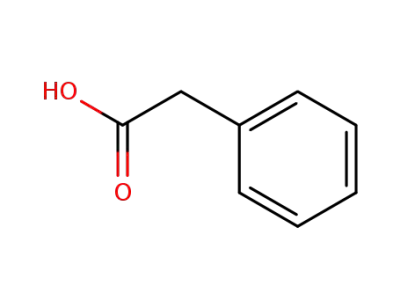
-
103-82-2
phenylacetic acid

-
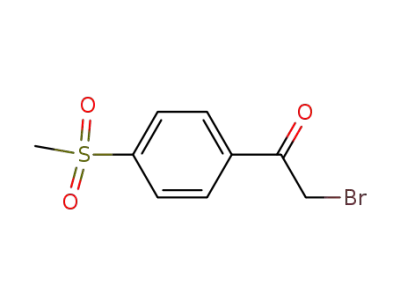
-
50413-24-6
2-bromo-1-(4-methanesulfonylphenyl)ethanone

-
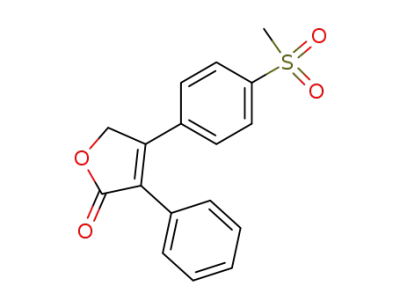
-
162011-90-7
rofecoxib
| Conditions | Yield |
|---|---|
|
phenylacetic acid;
With
sodium hydroxide;
In
DMF (N,N-dimethyl-formamide); water;
at 4 ℃;
for 1h;
2-bromo-1-(4-methanesulfonylphenyl)ethanone;
With
diisopropylamine;
at 45 ℃;
for 3.5h;
|
78% |
|
phenylacetic acid;
With
sodium hydroxide;
In
N,N-dimethyl-formamide;
at 20 ℃;
for 1h;
2-bromo-1-(4-methanesulfonylphenyl)ethanone;
In
N,N-dimethyl-formamide;
for 1h;
With
diisopropylamine;
In
N,N-dimethyl-formamide;
at 60 ℃;
for 4h;
|
76% |
|
phenylacetic acid; 2-bromo-1-(4-methanesulfonylphenyl)ethanone;
With
triethylamine;
In
acetonitrile;
at 20 - 25 ℃;
for 0.333333h;
With
1,8-diazabicyclo[5.4.0]undec-7-ene;
In
acetonitrile;
at 0 ℃;
for 0.333333h;
|
58% |
|
phenylacetic acid; 2-bromo-1-(4-methanesulfonylphenyl)ethanone;
With
triethylamine;
In
acetonitrile;
at 25 ℃;
for 0.333333h;
With
1,8-diazabicyclo[5.4.0]undec-7-ene;
In
acetonitrile;
at 0 ℃;
for 0.333333h;
|
54% |
|
With
1,8-diazabicyclo[5.4.0]undec-7-ene; triethylamine;
In
water; acetonitrile;
|
|
|
With
1,8-diazabicyclo[5.4.0]undec-7-ene; triethylamine;
In
water; acetonitrile;
|
|
|
With
1,8-diazabicyclo[5.4.0]undec-7-ene; triethylamine;
In
water; acetonitrile;
|
|
|
With
hydrogenchloride; 1,8-diazabicyclo[5.4.0]undec-7-ene; triethylamine;
In
(2S)-N-methyl-1-phenylpropan-2-amine hydrate; dichloromethane; ethyl acetate; acetonitrile;
|
36.6 g (58%) |
|
Multi-step reaction with 2 steps
1: triethylamine / acetonitrile / 25 °C
2: 1,8-diazabicyclo[5.4.0]undec-7-ene / acetonitrile
With
1,8-diazabicyclo[5.4.0]undec-7-ene; triethylamine;
In
acetonitrile;
1: |Horner-Wadsworth-Emmons Olefination / 2: |Horner-Wadsworth-Emmons Olefination;
|
-

-
162012-30-8
4-(4-(methylthio)phenyl)-3-phenylfuran-2(5H)-one
-
-
162011-90-7
rofecoxib
| Conditions | Yield |
|---|---|
|
With
3-chloro-benzenecarboperoxoic acid;
at 0 - 21 ℃;
|
99% |
|
With
Oxone;
In
water; acetone;
at 0 - 25 ℃;
for 24h;
Product distribution / selectivity;
|
95% |
|
With
oxone;
In
water; acetone;
at 0 - 25 ℃;
for 24h;
|
91% |
|
With
diethylene glycol dibutyl ether; oxygen;
at 110 ℃;
for 20h;
Green chemistry;
|
85% |
|
With
diethylene glycol dibutyl ether; oxygen;
at 110 ℃;
for 20h;
|
85% |
|
With
dihydrogen peroxide;
sodium tungstate;
In
acetic acid;
at 30 - 80 ℃;
for 2h;
|
82.7% |
|
With
Oxone; tetrabutylammomium bromide;
In
dichloromethane;
at 20 ℃;
for 46.5h;
|
80% |
|
With
oxygen; uranyl(VI) acetate dihydrate;
In
o-xylene; water; acetonitrile;
at 20 ℃;
under 760.051 Torr;
Schlenk technique;
Irradiation;
|
71% |
|
With
tetrabutylammonium tetrafluoroborate; oxygen;
In
dichloromethane;
at 20 ℃;
for 10h;
Electrochemical reaction;
Green chemistry;
|
57% |
|
With
dihydrogen peroxide;
sodium tungstate;
In
methanol; water;
at 42 ℃;
for 1h;
|
|
|
With
sodium tungstate (VI) dihydrate; dihydrogen peroxide;
In
water; acetonitrile;
at 65 - 70 ℃;
for 5.5h;
Solvent;
Temperature;
|
162011-90-7 Upstream products
-
162012-30-8
4-(4-(methylthio)phenyl)-3-phenylfuran-2(5H)-one
-
103-82-2
phenylacetic acid
-
50413-24-6
2-bromo-1-(4-methanesulfonylphenyl)ethanone
-
487047-31-4
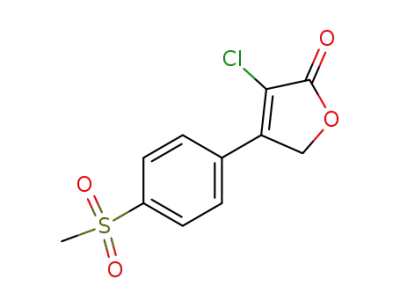
3-chloro-4-(4'-methylsulfonylphenyl)-5H-furan-2-one
162011-90-7 Downstream products
-
185147-17-5
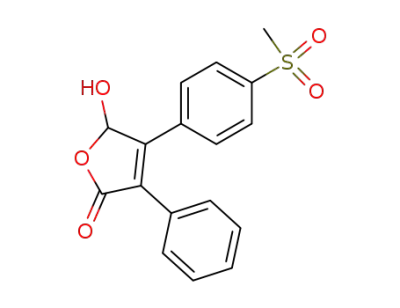
5-Hydroxyrofecoxib
-
179174-76-6
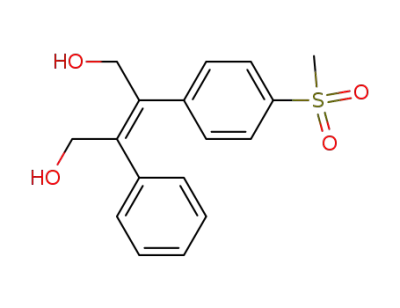
(2Z)-2-[4-(methylsulfonyl)phenyl]-3-phenylbut-2-ene-1,4-diol
-
691005-66-0
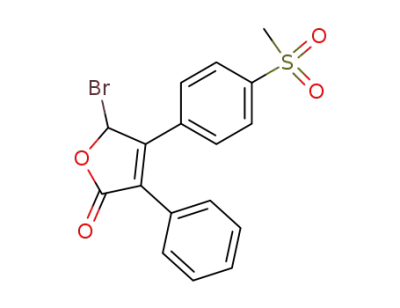
(+/-)-5-bromo-4-[4-(methylsulfonyl)phenyl]-3-phenylfuran-2(5H)-one
-
179175-15-6
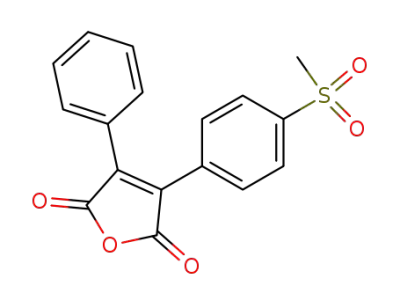
4-(4-(methylsulfonyl)phenyl)-3-phenylfuran-2(5H)-one