
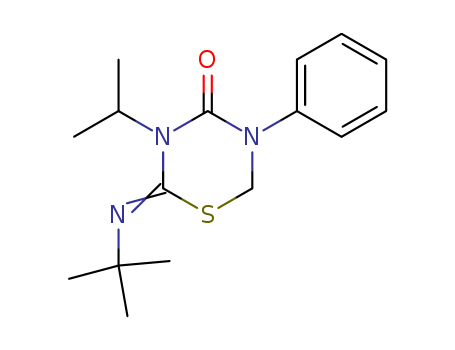
Buprofezin
- CasNo:69327-76-0
Product Description
Reputable supplier selling Buprofezin 69327-76-0 with stock
- Molecular Formula: C16H23N3OS
- Molecular Weight: 305.444
- Appearance/Colour: white to pale yellow crystalline powder
- Vapor Pressure: 8.12E-09mmHg at 25°C
- Melting Point: 104-106 °C
- Refractive Index: 1.52-1.522
- Boiling Point: 395 °C at 760 mmHg
- PKA: 3.02±0.20(Predicted)
- Flash Point: 192.7 °C
- PSA: 61.21000
- Density: 1.12 g/cm3
- LogP: 4.18510
Buprofezin(Cas 69327-76-0) Usage
|
Hazard |
Moderately toxic by ingestion. Low toxic- ity by skin contact. |
|
Trade name |
APPLAUD?; NNI-750? |
|
Pharmacology |
The foregoing indicates that the modes of action of buprofezin and benzoylureas could be similar or identical. However, one differing biochemical effect of buprofezin is inhibition of prostaglandin biosynthesis (33), a mechanism that has been suggested as responsible for its ovicidal activity. Subsequently, the in vitro and in vivo effects of buprofezin were found to be strongly antagonized by 20- hydroxyecdysone (34), which also affected prostaglandin biosynthesis. Thus, inhibition of both prostaglandin and chitin biosynthesis by buprofezin was prevented by 20- hydroxyecdysone, so that both effects of the insecticide are mediated via an effect on the hormone concentration or its receptor. Consequently, buprofezin seems to inhibit the drop in the 20-hydroxyecdysone titer that triggers epidermal cell proliferation, old cuticle digestion, and new cuticle deposition, but the detailed mechanism of this action has yet to be established. |
|
Metabolic pathway |
Buprofezin gradually decomposes in soils under flooded and upland conditions, with half-lives of 104 and 80 days, respectively. After 150 days, five degradation products are identified as 2-tert- butylimino-5-(4-hydroxyphenyl)-3-isopropylperhydro- 1,3,5-thiadiazin-4-one, 3-isopropyl-5-phenylperhydro- 1,3,5-thiadiazin-2,4-dione, 1-tert-butyl-3-ispropyl-5- phenylbiuret, 1-isopropyl-3-phenylurea, and phenylurea. As minor products, 2-tert-butylimino-5- phenylperhydro-1,3,5-thiadiazin-4-one or buprofezin sulfoxide are found in the flooded or in the upland soils. Since neither formation of 14CO2 nor hydroxylation is observed in the sterile soils, buprofezin seems to have undergone complete mineralization in soils under both conditions through biological transformation by soil microorganisms. |
|
Degradation |
Buprofezin (1) was degraded under acidic conditions with half-lives (DT50) f 6-12 days (pH 4), 34 days (pH 6) and 65 days (pH 10) at 40 °C. Opening of the thiadiazinanone ring appeared to be the primary hydrolytic degradation pathway, to yield 1-tert-butyl-3-isopropyl-5-phenyl-2- thiobiuret (2) and N-isopropyl-N-phenylurea (3) as major products. Buprofezin is stable to aqueous photolysis. The estimated DT50 of buprofezin in distilled water when exposed to UV light was 39 days. A more complex photodegradation pathway of buprofezin in methanol was reported recently (Datta and Walia, 1997) with DT9 values of 4 hours and 15 days under UV and sunlight irradiation, respectively. |
|
Agricultural Uses |
Insecticide, Acaricide, Insect growth regulator: For insect control in food crops and greenhouse ornamentals. |
InChI:InChI=1/C16H23N3O2S/c1-11(2)19-14(17-16(3,4)5)22-10-18(15(19)21)12-6-8-13(20)9-7-12/h6-9,11,20H,10H2,1-5H3/b17-14-
69327-76-0 Relevant articles
Method for continuously synthesizing buprofezin
-
Paragraph 0043-0061, (2020/12/30)
The invention discloses a method for con...
Synthesis method of buprofezin
-
Paragraph 0045; 0054-0081, (2019/08/03)
The invention provides a synthesis metho...
Preparation method of buprofezin
-
, (2018/10/11)
The invention provides a preparation met...
Buprofenzin process for the preparation of
-
Paragraph 0010; 0013-0015; 0018-0020; 0023-0025; 0028-0030, (2019/11/28)
The invention relates to a preparation m...
69327-76-0 Process route
-
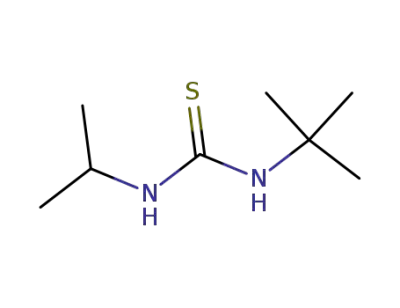
-
52599-24-3
N-tert-butyl-N'-isopropylthiourea

-
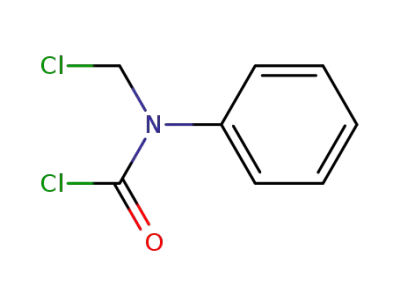
-
52123-54-3
N-Chloromethyl-N-phenylcarbamoyl chloride

-
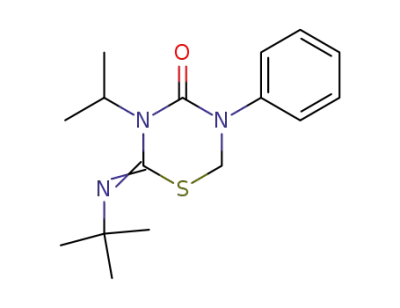
-
69327-76-0,953030-84-7
buprofezin
| Conditions | Yield |
|---|---|
|
N-Chloromethyl-N-phenylcarbamoyl chloride;
With
dipotassium peroxodisulfate; 3,6-dimethyl-3,6-dihydroperoxy-4,5-dioxaoctane;
at 40 - 45 ℃;
Flow reactor;
Large scale;
N-tert-butyl-N'-isopropylthiourea;
With
tetradecyltrimethylammonium chloride; calcium hydroxide;
at 15 - 50 ℃;
Reagent/catalyst;
Temperature;
Flow reactor;
Large scale;
|
92.3%
|
|
With
sodium acetate;
In
water; toluene;
at 30 - 45 ℃;
for 2h;
Temperature;
Reagent/catalyst;
|
87%
|
|
With
sodium hydrogencarbonate;
In
water; chlorobenzene;
at 0 - 30 ℃;
for 5.5h;
Green chemistry;
|
|
|
With
ammonia;
In
1,4-dioxane;
at 10 - 40 ℃;
for 5h;
Reagent/catalyst;
|
-
-
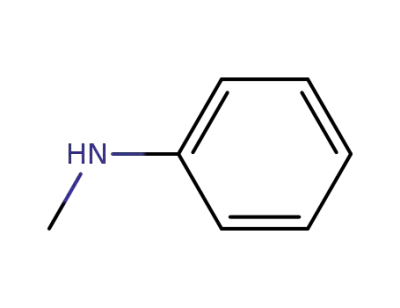
100-61-8
N-methylaniline
-
-
69327-76-0,953030-84-7
buprofezin
| Conditions | Yield |
|---|---|
|
Multi-step reaction
with
3
steps
1: chlorine / chlorobenzene / 40 °C / Green chemistry
2: chlorobenzene / Green chemistry
3: sodium hydrogencarbonate / water; chlorobenzene / 5.5 h / 0 - 30 °C / Green chemistry
With
chlorine; sodium hydrogencarbonate;
In
water; chlorobenzene;
|
|
|
Multi-step reaction
with
3
steps
1: chloroform / 15 - 50 °C
2: 2,2'-azobis(isobutyronitrile); chlorine / 55 °C
3: ammonia / 1,4-dioxane / 5 h / 10 - 40 °C
With
2,2'-azobis(isobutyronitrile); ammonia; chlorine;
In
1,4-dioxane; chloroform;
|
|
|
Multi-step reaction
with
3
steps
1.1: n-butyl formate / 50 - 60 °C / Flow reactor; Large scale
2.1: hydrogenchloride / 50 - 60 °C / Flow reactor; Large scale
3.1: 3,6-dimethyl-3,6-dihydroperoxy-4,5-dioxaoctane; dipotassium peroxodisulfate / 40 - 45 °C / Flow reactor; Large scale
3.2: 15 - 50 °C / Flow reactor; Large scale
With
hydrogenchloride; dipotassium peroxodisulfate; n-butyl formate; 3,6-dimethyl-3,6-dihydroperoxy-4,5-dioxaoctane;
|
69327-76-0 Upstream products
-
590-42-1
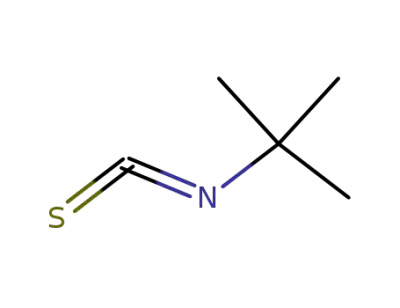
tert-butyl isothiocyanate
-
52599-24-3
N-tert-butyl-N'-isopropylthiourea
-
52123-54-3
N-Chloromethyl-N-phenylcarbamoyl chloride
-
100-61-8
N-methylaniline